


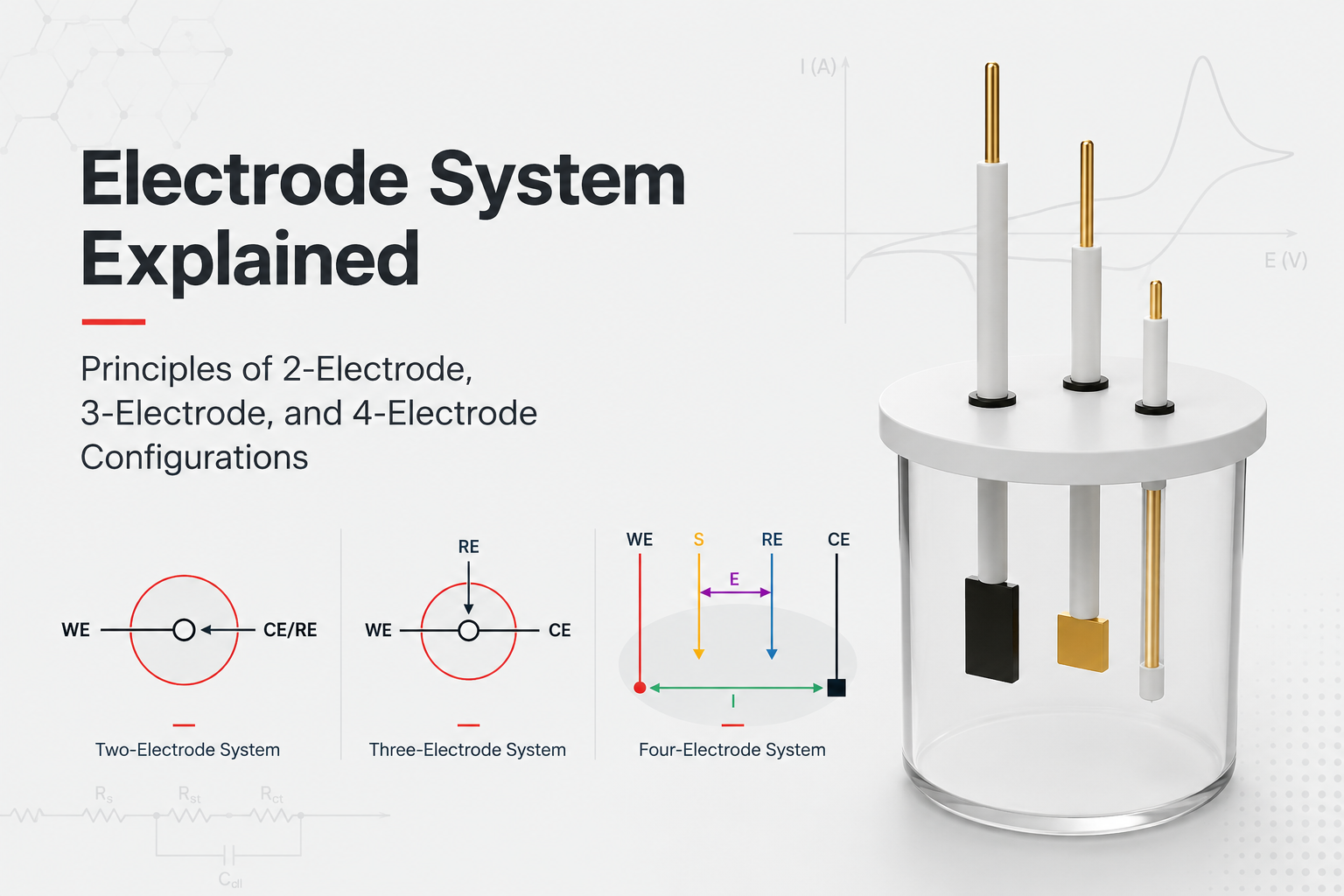
Electrode System Explained: Principles of 2-Electrode, 3-Electrode, and 4-Electrode Configurations

Introduction
Electrochemistry advances scientific understanding across a wide range of applications by controlling and measuring chemical phenomena and their associated physical responses.
Over the years, numerous electrochemical techniques have been developed to meet different research objectives. These methods range from simple potentiostatic measurements, such as Chronoamperometry (CA), to dynamic potential-sweep techniques like Cyclic Voltammetry (CV), and more advanced AC-based methods such as Electrochemical Impedance Spectroscopy (EIS).
In addition, even when the same electrochemical technique is used, multiple experimental configurations may be available, with certain setups being better suited for specific research goals than others.
One of the most important aspects of experimental design is the electrode configuration—that is, the number of electrodes (or probes) used and how they are connected within the electrochemical cell.
This article explains the principles and applications of two-electrode, three-electrode, and four-electrode systems, and discusses how electrode configuration influences potential control, current flow, measurement accuracy, and data interpretation.
What Is an Electrode System?
An electrode system refers to the number of electrodes used in an electrochemical cell and the specific role each electrode plays during a measurement.
In simple terms:
Electrode System = Number of Electrodes + Electrode Functions + Current Path + Potential Measurement Path
Different electrode configurations determine how current flows through the electrochemical cell, where potential is measured, and how accurately the working electrode potential can be controlled. As a result, the electrode system has a direct impact on measurement accuracy, data reliability, and experimental reproducibility.
An electrode system primarily influences:
- Current Path – how current flows through the electrochemical cell
- Potential Measurement Path – where potential is measured
- Potential Control Accuracy – how precisely the working electrode potential can be controlled
- Measurement Accuracy and Reproducibility – the quality and consistency of experimental results
Understanding electrode systems is essential for selecting the appropriate two-electrode, three-electrode, or four-electrode configuration and for obtaining reliable and reproducible electrochemical data.
Comparison of Electrode Configurations
| Configuration | Electrodes | Main Advantage | Key Limitation | Typical Applications |
|---|---|---|---|---|
| Two-electrode | WE + CE/RE combined | Simple setup; measures full cell voltage directly | Poor control of WE potential; includes all voltage drops | Batteries, fuel cells, electrolysis, basic impedance tests |
| Three-electrode | WE + CE + RE | Accurate control of WE potential vs RE | Affected by solution resistance (iR drop) | CV, EIS, electrocatalysis, corrosion, kinetics |
| Four-electrode | 2 current + 2 sense leads | Separates current and voltage paths; high accuracy | More complex setup and instrumentation | Membrane impedance, conductivity, solid-state systems |
Quick Selection Guide
| Experimental Goal | Recommended Configuration |
|---|---|
| Battery, Fuel Cell, or Supercapacitor Testing (Full Device) | Two-Electrode System |
| Cyclic Voltammetry (CV) | Three-Electrode System |
| Electrochemical Impedance Spectroscopy (EIS) for Electrode Interface Studies (Electrocatalysis, Corrosion, Sensors) | Three-Electrode System |
| Electrochemical Impedance Spectroscopy (EIS) for Full-Cell Testing | Two-Electrode System |
| Electrocatalysis Research (HER, OER, CO₂RR) | Three-Electrode System |
| Corrosion Testing | Three-Electrode System |
| Membrane Resistance Measurement | Four-Electrode System |
| Electrolyte Conductivity Measurement | Four-Electrode System |
| Solid-State Electrolyte Characterization | Four-Electrode System |