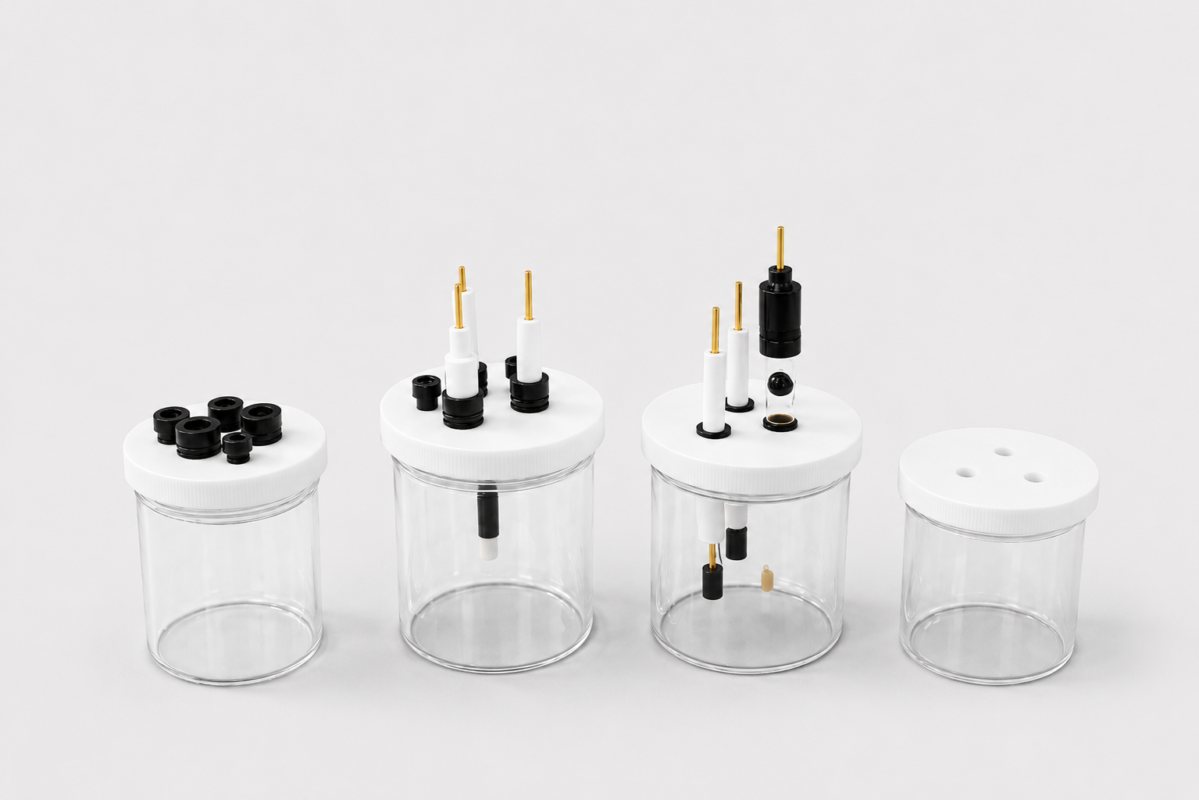
Designed for gas-tight experiments and high-precision electrochemical measurements. Durable structure with customizable electrode ports to fit your research needs.
Electrochemical System Design refers to the engineering-oriented approach to building a complete electrochemical experimental setup, where electrodes, electrolyte, cell geometry, and boundary conditions are treated as an integrated system rather than independent components.
In electrochemistry, experimental results are not determined by material properties alone. Instead, they emerge from the interaction between:
Working electrode structure and surface state
Reference electrode positioning and stability
Counter electrode area and polarization behavior
Electrolyte composition, conductivity, and chemical compatibility
Cell geometry and current distribution
Boundary conditions such as temperature, atmosphere, and mass transport
A well-designed electrochemical system ensures:
Stable and reproducible potentials
Minimized iR drop and field distortion
Controlled current distribution
Defined geometric and effective surface areas
Consistent mass transport conditions
In other words:
Electrochemical data ≠ intrinsic material property
Experimental data = Material × Electrode System × Electrolyte × Cell Geometry × Boundary Conditions
Electrochemical System Design transforms electrochemistry from a “trial-and-error measurement” into a controllable engineering process.
Unstable electrochemical data is often caused by poor system control rather than the potentiostat itself. Learn the common causes of noise, oscillation, drift, and unstable CV/EIS results in electrochemical experiments.
This guide explains how electrochemical system design affects data stability, sensitivity, and reproducibility, covering electrodes, electrolytes, electrochemical cells, and common troubleshooting methods.
This guide explains common causes of unstable electrochemical data, including electrode contamination, wiring issues, electrolyte problems, and improper experimental configurations in electrochemical systems.
Learn how to properly polish and prepare electrochemical electrodes for accurate and reproducible measurements. This practical guide covers electrode surface preparation methods, polishing materials, cleaning steps, and best practices for glassy carbon, gold, and platinum electrodes used in electrochemistry experiments.
Learn the principles, advantages, and limitations of 2-electrode, 3-electrode, and 4-electrode electrochemical systems. This practical guide explains current paths, potential control, iR drop, and how to choose the right configuration for CV, EIS, batteries, corrosion studies, and impedance measurements.