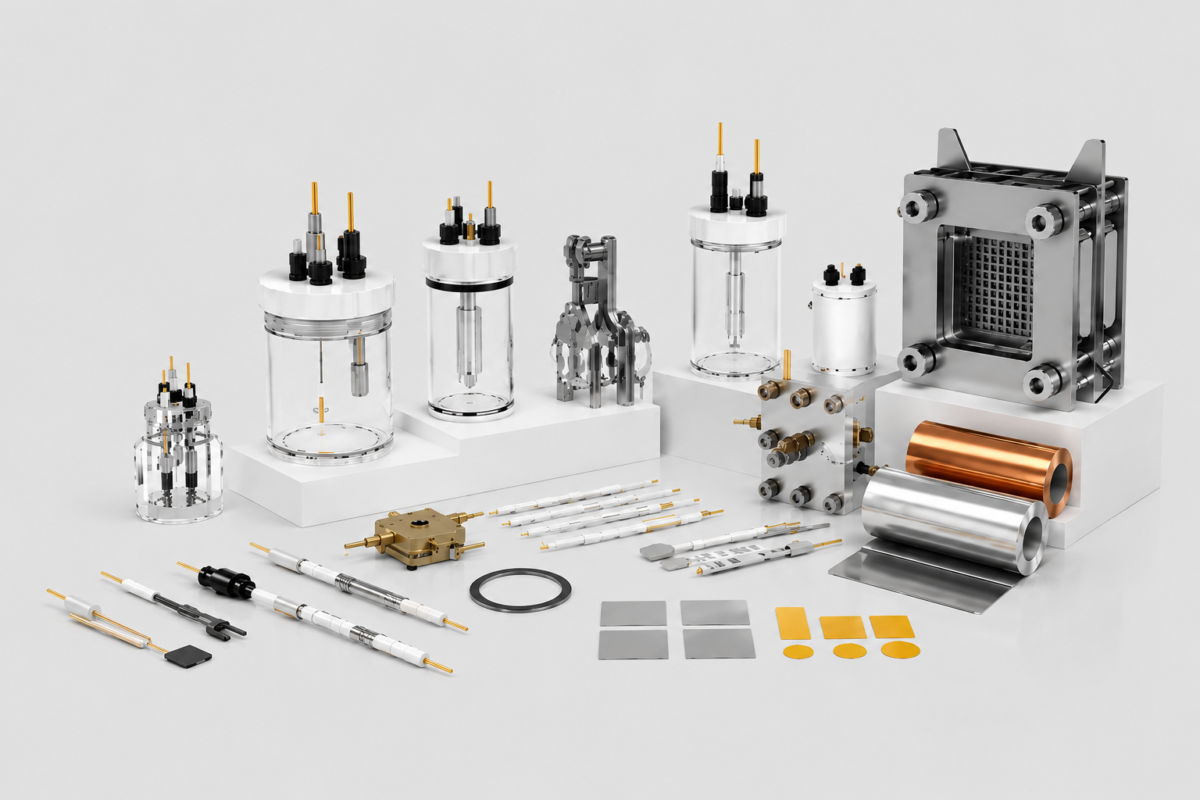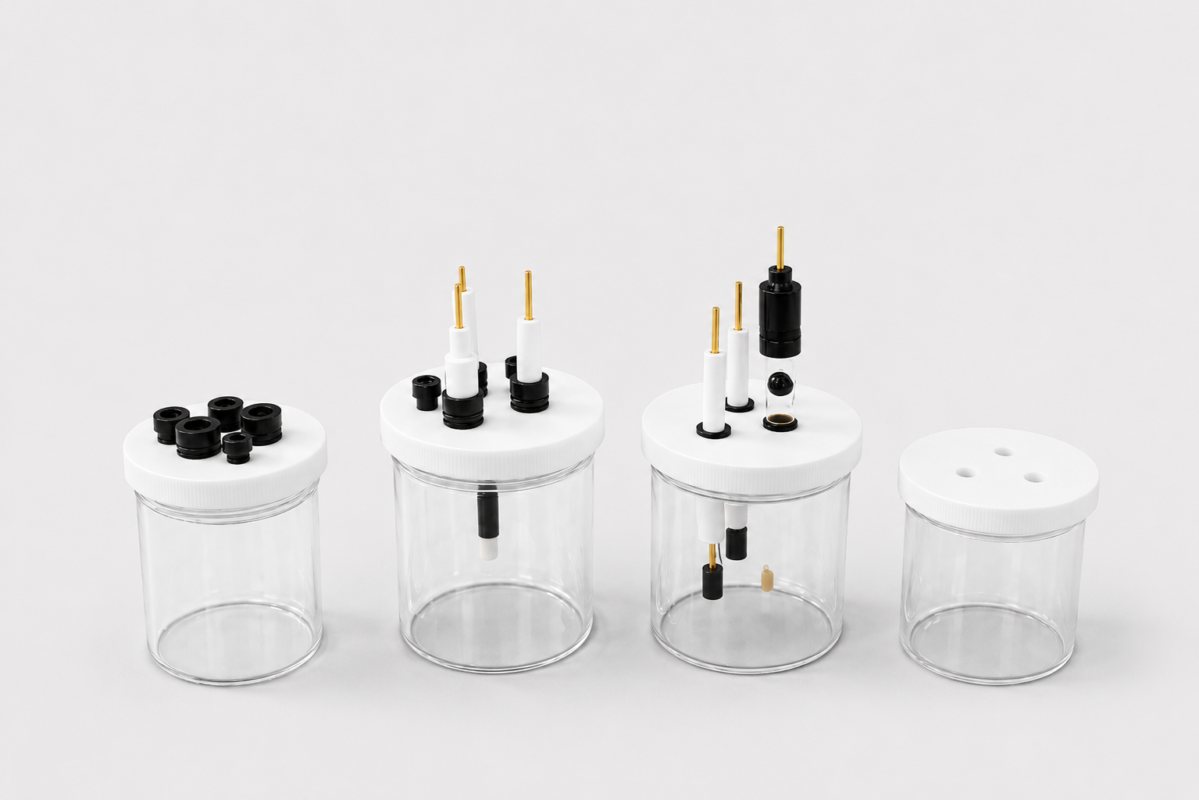

- Acrylic Electrochemical Cells
- All-PTFE Electrochemical Cells
- Corrosion Electrochemical Cells
- Five-Neck Sealed Cells
- H-Type Electrochemical Cells
- Large-Volume Sealed Cells
- Microvolume Sealed Cells
- Microbial Fuel Cells (MFCs)
- Optical Electrochemical Cells
- Other Electrochemical Cells
- Quartz Electrochemical Cells
- Three-Electrode Cells
- Ultra-Sealed Electrochemical Cells
- Water-Jacketed Cells
Electrode Types and Selection Guide for Electrochemistry

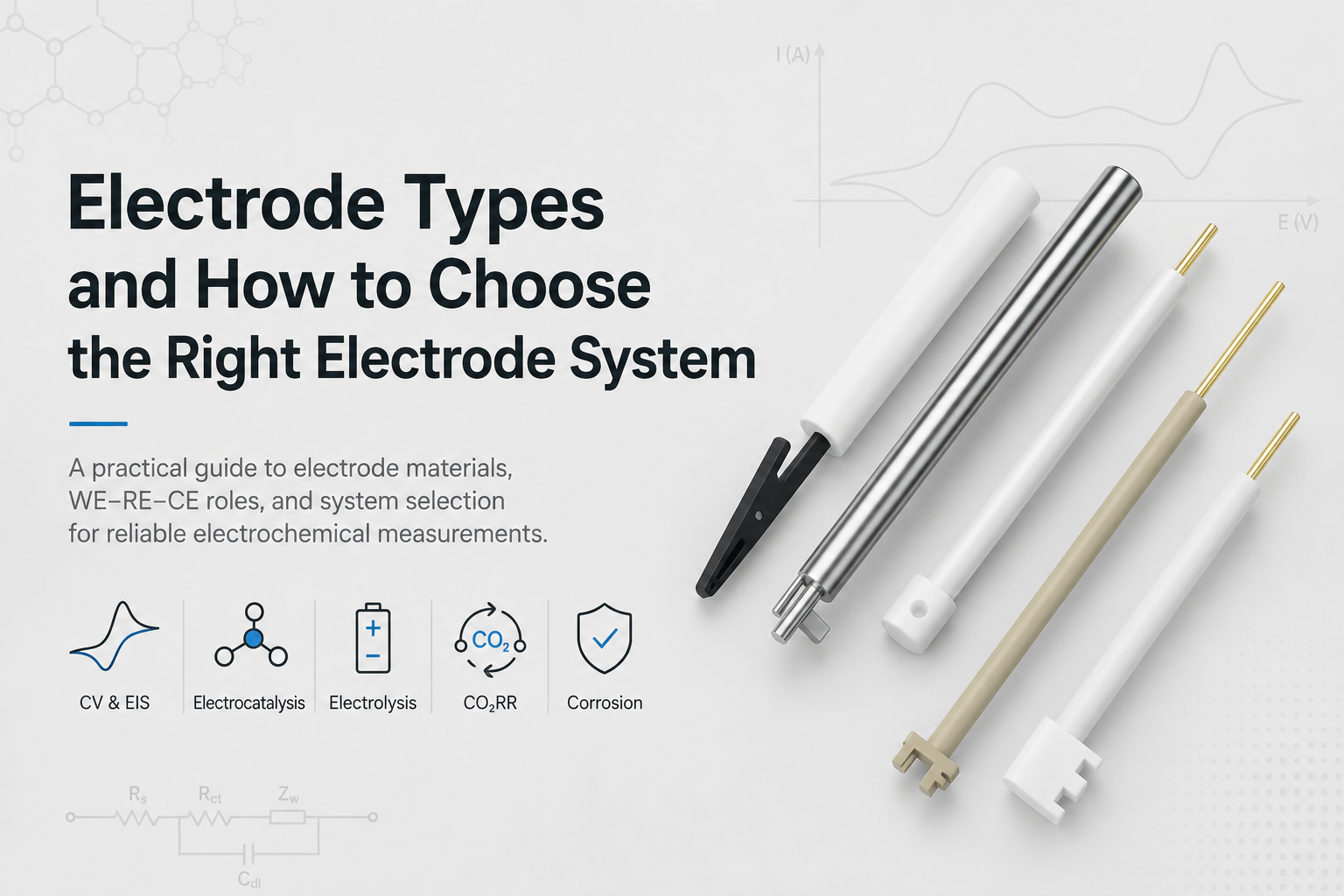
A practical guide to working electrode, reference electrode and counter electrode selection for CV, EIS, corrosion, electrocatalysis, sensors, RDE/RRDE and routine electrochemical testing
Quick Answer: How Do You Choose Electrodes for Electrochemistry?
Choose the electrode role first, then choose the material. The working electrode is selected for the reaction or surface you want to study. The reference electrode is selected for a stable potential scale in your electrolyte. The counter electrode is selected to carry current without becoming the limiting or contaminating part of the experiment.
This guide focuses on electrode types and electrode material selection. It is not a full tutorial on two-, three- and four-electrode configurations. If you need to decide whether your experiment should use a 2-electrode, 3-electrode or 4-electrode arrangement, read the dedicated 2-, 3- and 4-Electrode Systems Explained guide.
Electrode Selection Matrix
| Electrode role | Common choices | Best used for | Selection risk |
|---|---|---|---|
| Working electrode | Glassy carbon, gold, platinum, carbon steel, stainless steel, SPE, RDE/RRDE | Studying the target reaction, material surface or sensing interface | Wrong surface area, poor polishing, unsuitable potential window, material interference |
| Reference electrode | Ag/AgCl, SCE, Hg/HgO, Cu/CuSO4, non-aqueous reference | Providing a stable potential scale for the working electrode | Drift, chloride contamination, dry junction, wrong electrolyte compatibility |
| Counter electrode | Platinum wire, platinum sheet, platinum mesh, graphite rod, large-area inert conductor | Completing the current path without limiting the working electrode reaction | Counter polarization, side products, metal dissolution, product crossover |
Introduction
Electrode selection sounds simple until the data start to disagree. A glassy carbon electrode may work beautifully for one cyclic voltammetry test and fail to give a clean response in another. A platinum counter electrode may be convenient in routine work but unsuitable when counter-side products can reach the working electrode. A reference electrode may appear stable at the beginning of a run and then slowly shift because the filling solution, junction or electrolyte is mismatched.
That is why electrode choice should not be treated as a shopping list. Each electrode has a job. The working electrode defines the surface being studied. The reference electrode defines the potential scale. The counter electrode carries the current. When these roles are mixed together, the experiment becomes harder to interpret.
This article reorganizes electrode selection around practical laboratory decisions: what material to choose, what each electrode is responsible for, when glassy carbon is better than gold or platinum, when a corrosion sample should be the working electrode, when a reference electrode can contaminate the system, and when a large counter electrode or separated cell is needed.
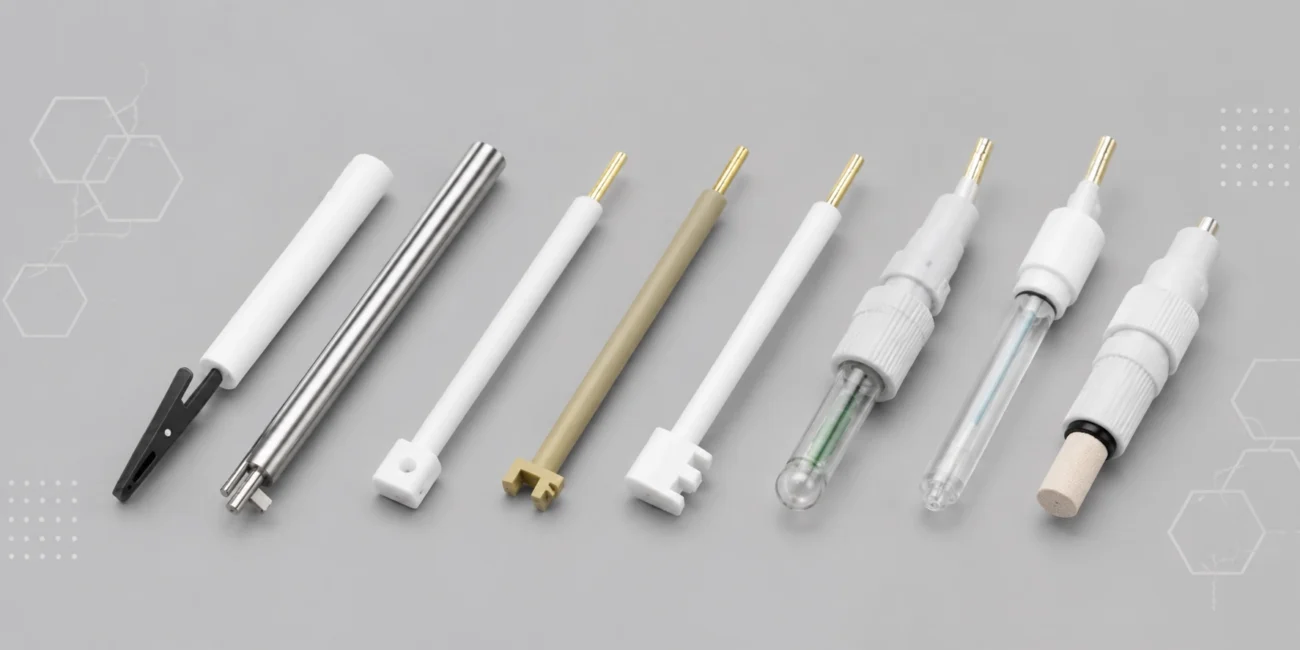
Figure 1. Electrode selection starts by separating the three roles: working, reference and counter electrodes.
1. Start With the Electrode Role
Before comparing electrode materials, decide what the electrode must do in the measurement. A material can be excellent in one role and inappropriate in another. Platinum, for example, is often used as a counter electrode because it is conductive and durable, but as a working electrode it can catalyze hydrogen, oxygen or other reactions that may interfere with interpretation.
The working electrode should match the reaction or surface you want to study. For a redox probe, a polished glassy carbon disk may be ideal. For gold-thiol chemistry or biosensor immobilization, gold may be the better interface. For corrosion testing, the metal sample itself is usually the working electrode. For mass-transport controlled kinetics, an RDE or RRDE working electrode provides a more controlled hydrodynamic condition than a stationary disk.
The reference electrode should match the electrolyte and potential scale. It should be stable, well maintained and placed consistently. The counter electrode should be large enough and chemically compatible enough to carry current without becoming the bottleneck.
A useful rule is to write the electrode role in your notebook before writing the electrode material: “working electrode: polished glassy carbon disk, 3 mm”; “reference electrode: Ag/AgCl in saturated KCl”; “counter electrode: platinum mesh, separated if needed.” This habit prevents a lot of vague method descriptions later.
2. Working Electrode Materials
The working electrode is the most visible part of the experiment because it is where the main electrochemical response is interpreted. Choose it according to the reaction, electrolyte, potential window, surface preparation, geometry and reporting requirement. Do not choose only because a material is common.
Glassy Carbon Electrode
Glassy carbon is a reliable general-purpose working electrode for many CV, LSV, EIS and electrocatalysis screening experiments. It has a broad useful potential window in many aqueous electrolytes, relatively low background current, good chemical resistance and a polishable surface. For redox probes, catalyst inks and routine method development, it is often the first electrode to try.
The main strength of glassy carbon is repeatability when the surface is prepared well. A poorly polished glassy carbon electrode can give broader peaks, higher background current and worse repeatability. If the experiment compares peak current or current density, the exposed geometric area must be known and the polishing process should be kept consistent.
Glassy carbon is not automatically inert to every surface chemistry. Catalyst inks, binders, adsorbed organic species and strong oxidative conditions can change the response. For serious comparison, record polishing particle size, cleaning solvent, sonication step and drying condition.
Gold Electrode
Gold is selected when the surface chemistry of gold matters. It is common in self-assembled monolayers, biosensors, thiol chemistry, interface engineering, surface modification and some analytical methods. If the experiment depends on controlled molecular attachment or a noble metal surface with strong documentation in the literature, gold can be the correct working electrode rather than a luxury choice.
Gold is not simply a more expensive version of glassy carbon. It has its own adsorption behavior and potential limits. Chloride-containing electrolytes, oxide formation, surface contamination and cleaning history can all affect the response. If the experiment uses gold as a platform for surface modification, the surface preparation method should be part of the protocol, not an afterthought.
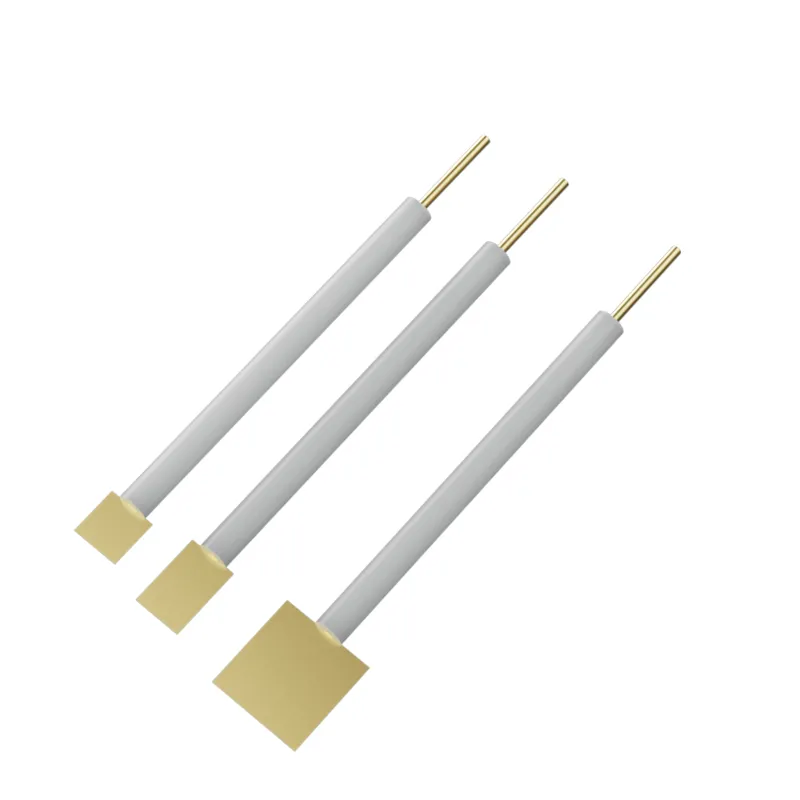
Figure 2. Gold electrodes are useful when gold surface chemistry, immobilization or noble-metal interface behavior is part of the method.
Platinum Electrode
Platinum is widely used because it is conductive, mechanically robust and chemically resistant in many conditions. It is common as a counter electrode and can also be used as a working electrode when a platinum surface is intentionally required. Platinum is especially familiar in hydrogen-related reactions, oxygen reactions and many benchmark electrochemical tests.
The caution is that platinum is catalytically active. That activity is useful when platinum behavior is the target, but it can be a problem when the platinum surface creates reactions that are not part of the intended study. For example, hydrogen evolution, oxygen reduction, adsorption and surface oxide formation may complicate interpretation.
When using platinum as a counter electrode, also consider whether products generated at the counter side can migrate to the working electrode. In long electrolysis, gas evolution, product analysis or sensitive catalysis, a divided cell may be safer.
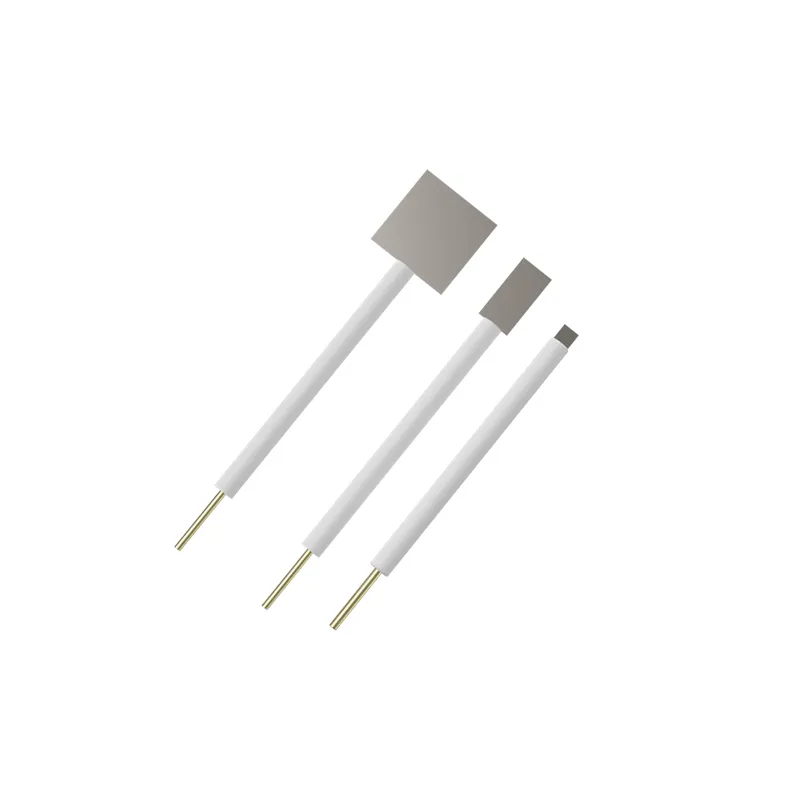
Figure 3. Platinum is useful for conductive and chemically resistant electrodes, but its catalytic activity should be considered.
Carbon Steel, Stainless Steel and Custom Metal Samples
When corrosion behavior, passivation, coating performance or alloy comparison is the target, the working electrode should often be the actual metal sample. Carbon steel, stainless steel, copper, titanium, aluminum, nickel alloys and coated metals are not just electrode accessories in this case. They are the material being measured.
The key issue is not only material grade. Surface finish, exposed area, edge sealing, electrical contact, immersion time and pre-treatment can dominate the result. A carbon steel sample with a leaking edge or uneven mask can produce misleading current density. A polished alloy sample and a rough industrial sample may describe different questions even if the alloy name is the same.
For corrosion tests, document the sample area, polishing grit, cleaning process, electrolyte, immersion time before measurement and reference electrode used. If the data are meant for comparison, the sample preparation must be as repeatable as the electrochemical method.
Screen-Printed Electrodes
Screen-printed electrodes are useful for sensors, disposable testing, small-volume work and fast screening. They often combine working, reference and counter areas on one strip, which makes them convenient for practical measurement. The tradeoff is that the printed reference and counter areas may not behave exactly like separate laboratory electrodes.
Use screen-printed electrodes when convenience, reproducibility across disposable strips or a compact sensor format is more important than full flexibility in electrode placement. Check adapter compatibility, contact quality, printed reference stability and the usable potential window of the printed material.
For low-current sensor work, do not ignore the connector. A misaligned adapter, oxidized contact or bent pin can look like a chemistry problem. If several strips give inconsistent baselines, test the adapter and connection before changing the electrode chemistry.
Rotating Disk and Rotating Ring-Disk Electrodes
RDE and RRDE electrodes are chosen when mass transport and reaction pathway matter. A rotating disk electrode creates controlled convection near the working surface, which helps separate kinetic behavior from diffusion effects. A rotating ring-disk electrode adds a ring around the disk so products formed at the disk can be detected at the ring.
Use RDE for kinetic analysis, catalyst comparison and mass-transport studies where rotation rate is part of the method. Use RRDE when intermediate detection, product collection efficiency or mechanism study is important. These tools are more demanding than stationary electrodes because polishing, centering, rotation rate, collection efficiency and electrolyte cleanliness all influence the result.

Figure 4. RDE and RRDE electrodes are selected when controlled mass transport or intermediate detection is required.
Common Working Electrode Choices
| Working electrode | Why choose it | Watch for |
|---|---|---|
| Glassy carbon | General CV, EIS, redox probes, catalyst ink screening | Polishing quality, surface contamination, exposed area |
| Gold | SAMs, biosensors, surface immobilization, noble-metal interfaces | Chloride effects, oxide formation, adsorption history |
| Platinum | Benchmark noble metal surface, hydrogen/oxygen related reactions | Catalytic side reactions and surface oxide behavior |
| Carbon steel or alloy sample | Corrosion, passivation, coating and material evaluation | Edge sealing, surface finish, exposed area, immersion time |
| Screen-printed electrode | Sensors, disposable testing, small volume, fast screening | Adapter contact, printed reference stability, strip variation |
| RDE/RRDE | Kinetics, mass transport, mechanism and intermediate detection | Rotation rate, polishing, alignment, collection efficiency |
3. Reference Electrode Selection
The reference electrode is the potential ruler of the experiment. If the ruler moves, every potential value becomes questionable. A good working electrode cannot compensate for a drifting or incompatible reference electrode.
In aqueous electrochemistry, Ag/AgCl and SCE are common reference choices, with the right choice depending on electrolyte, chloride tolerance, temperature and laboratory convention. Hg/HgO is often used in alkaline systems. Cu/CuSO4 is common in some corrosion and field measurements. Non-aqueous systems require special care because solvent compatibility, junction potential and reference stability can become limiting.
Choose the reference electrode by asking four questions: is it chemically compatible with the electrolyte, is the filling solution acceptable for the experiment, can the junction stay wet and stable, and can the potential scale be clearly reported? If any answer is uncertain, verify the reference before trusting small potential shifts.
Reference placement also matters. A reference electrode placed too far from the working electrode can increase uncompensated resistance error. A reference placed too close can disturb the flow field, block the surface or create local contamination. For repeatable work, keep the placement consistent and record the approximate distance or use a fixed cell geometry.
Reference electrode practical note. Many unexplained peak shifts, OCP drift and corrosion potential changes come from the reference electrode rather than the sample. Before rewriting the method, check the filling solution, junction, storage condition, bubbles, salt bridge and position near the working electrode.
4. Counter Electrode Selection
The counter electrode is sometimes treated as a background part, but it controls the current path. It should be conductive, chemically stable in the electrolyte and large enough that it does not limit the working electrode reaction. A small or poorly placed counter electrode can cause polarization, distorted curves, compliance problems and poor repeatability.
For routine low-to-moderate current tests, platinum wire, platinum sheet, platinum mesh or graphite rods are common choices. For higher current experiments, a larger counter electrode area is usually safer. The counter electrode area is often larger than the working electrode area so the counter side does not become the limiting interface. For a geometry-specific comparison, see Platinum Counter Electrode: Mesh vs Sheet vs Wire.
Counter electrode material can matter when side products or dissolved species affect the working electrode. Platinum may be durable, but it can generate products or release trace species under some conditions. Graphite may be useful in some systems, but it is not universally inert. For product-sensitive electrolysis, catalyst testing, CO2 reduction, gas evolution or long-term experiments, consider a divided cell, H-type cell or membrane separation.
Position is also important. A counter electrode placed too close can create uneven current distribution. A counter electrode placed poorly can shade an illuminated working electrode in photoelectrochemistry or trap bubbles in the current path. Treat counter placement as part of the method, not as a casual accessory decision.
5. Electrode Material Compatibility
Electrode material compatibility includes more than corrosion resistance. A material may be chemically stable but still unsuitable because it adsorbs the analyte, catalyzes an unwanted reaction, dissolves under polarization, narrows the usable potential window or releases species that interfere with the measurement.
For aqueous acid, base and neutral electrolyte, check the stability of the working electrode, counter electrode, reference electrode junction and electrode holder. For organic solvents, confirm that the electrode sleeve, seal, adhesive and reference electrode are compatible. For high-temperature, UV, gas evolution or long electrolysis, compatibility should be checked under real operating conditions rather than only from a static chemical chart.
Potential window is part of compatibility. The same electrode material can be acceptable in one electrolyte and problematic in another. Background current, surface oxide formation, gas evolution and electrolyte breakdown should be checked before interpreting peaks near the edge of the usable window.
Material Selection Checklist
| Question | Why it matters | Typical action |
|---|---|---|
| Does the electrode survive the electrolyte? | Prevents corrosion, dissolution or swelling around the electrode assembly | Check acid/base/solvent compatibility before long tests |
| Is the surface electrochemically quiet enough? | Background current can hide small signals | Run blank electrolyte before sample measurement |
| Does the material catalyze side reactions? | Unwanted hydrogen, oxygen or adsorption behavior can confuse interpretation | Compare blank response and choose a less active surface if needed |
| Is the exposed area well defined? | Current density and reproducibility depend on real area control | Use a fixed holder, mask or polished disk with known area |
| Can the surface be prepared repeatably? | Surface history changes peak shape and current | Document polishing, cleaning, activation and storage |
6. Geometry, Area and Surface Preparation
Many electrode problems are geometry problems wearing a chemistry mask. If the exposed working electrode area changes, current changes. If the reference electrode position moves, potential error changes. If the counter electrode area is too small, the current path changes. If the sample edge leaks, corrosion current becomes meaningless.
For disk electrodes, record the diameter and exposed area. For sheet electrodes, record the immersed area and whether both sides are exposed. For custom samples, define whether edges and backsides are sealed. For porous electrodes and catalyst films, geometric area, loading and electrochemically active surface area are not the same thing, so the reporting method should be clear.
Surface preparation should match the electrode type. Glassy carbon and noble metal disks often need polishing and cleaning before repeatable CV. Metal corrosion samples may need controlled grinding, degreasing and immersion time. Screen-printed electrodes may be used as received or preconditioned according to the method. RDE/RRDE electrodes need careful polishing and alignment because rotation exaggerates small preparation differences.
For detailed polishing and cleaning workflow, use the Electrode Polishing Guide.
7. Match Electrode Choice to the Application
Routine CV and EIS Method Development
For routine CV and EIS with redox probes or simple electrolyte tests, glassy carbon is often the clean starting point. It is easy to polish, widely reported and less catalytically aggressive than platinum for many reactions. Use a stable reference electrode and a counter electrode with enough area. Run a blank electrolyte first so background behavior is known.
Corrosion and Coating Evaluation
For corrosion studies, the sample material should usually be the working electrode. Focus on surface finish, exposed area, edge sealing, electrolyte composition, immersion time and reference electrode stability. A beautiful polarization curve is not meaningful if the sample area leaks or the reference electrode drifts.
Electrocatalysis
For electrocatalysis, choose the working electrode according to whether the catalyst is deposited on a support or tested as a bulk material. Glassy carbon is common for catalyst ink screening. RDE is useful when kinetic and diffusion effects need to be separated. Use a counter electrode that can carry the current, and consider separation if counter products can interfere.
Sensors and Biosensors
Sensor work often favors gold, carbon, modified glassy carbon or screen-printed electrodes depending on the immobilization chemistry and detection target. Contact stability, surface cleanliness and low background current are often more important than maximum current capacity. For disposable sensors, batch-to-batch variation and adapter connection quality should be checked.
Battery, Membrane and Full-Cell Work
When the target is full-cell behavior, electrode selection follows the device question. The two active electrodes may both be part of the measurement rather than one being a simple counter electrode. If individual electrode potentials are needed, add a reference electrode or use a cell designed for that purpose. For configuration logic, use the 2-, 3- and 4-Electrode Systems Explained guide.
Photoelectrochemistry
Photoelectrochemical tests add illumination area, window material, light path and shading to normal electrode selection. The working electrode may be a photoelectrode, the counter electrode should not block light, and the reference electrode should be placed consistently without disturbing the illuminated region. For cell body and window choices, see Quartz, Glass or PTFE: Choosing a Photoelectrochemical Cell.
8. Common Electrode Selection Mistakes
Choosing platinum because it feels universal. Platinum is useful, but it is not neutral in every experiment. If a platinum surface catalyzes a reaction that overlaps your target signal, it may make interpretation harder rather than easier.
Ignoring the reference electrode until the curve shifts. Potential shifts are often blamed on the working electrode first. Check the reference electrode condition, filling solution, junction, bubbles and placement before assuming the material changed.
Using a counter electrode that is too small. A small counter electrode can polarize or limit current. Use sufficient area, good immersion and a compatible material. For long or product-sensitive tests, consider separation.
Reporting current density without defining area. Current density only makes sense when the area is defined. For custom samples, record the exposed area, edge sealing and whether one or both sides are active.
Changing surface preparation between repeats. If polishing, cleaning, activation or drying changes between runs, the electrode surface has changed. Keep preparation consistent before comparing materials.
Quick Troubleshooting Table
| Symptom | Electrode-related cause | First check |
|---|---|---|
| CV peaks shift between runs | Reference drift, iR drop, changed surface state | Reference electrode, WE-RE distance, polishing routine |
| Current density is not repeatable | Changing exposed area, sample edge leakage, film loss | Holder, mask, sample mounting, active area definition |
| High background current | Dirty working electrode, narrow potential window, side reaction | Blank electrolyte, polishing, material/electrolyte compatibility |
| Current is limited at high load | Small counter electrode, poor CE contact, low conductivity | Counter area, immersion, electrolyte resistance |
| Unexpected products or contamination | Counter reaction crossover or reference leakage | Divided cell, salt bridge, reference filling solution |
| Noisy low-current signal | Poor contact, unstable adapter, moving cable | Clip/contact quality, SPE adapter, cable shielding |
9. Related PotentioLab Electrode Categories
Useful product starting points. The best electrode choice depends on chemistry, method and cell geometry. These categories are useful starting points when matching electrode role to experiment.
- Working Electrodes for glassy carbon, noble metal, custom sample and application-specific working electrode choices.
- Reference Electrodes for stable potential control in aqueous, alkaline, corrosion and specialized systems.
- Electrode Holders and Accessories for fixed exposed area, cleaner contacts and more repeatable sample mounting.
- Electrochemical Cells when electrode spacing, sealing, gas control or separation must be controlled.
10. What to Send When Asking for Electrode Selection Support
If you need help choosing electrodes, send the experiment goal first. The most useful information is the method, electrolyte, potential range, expected current, working electrode material, whether products need separation, whether gas or light is involved, and whether the result will be reported as current, current density, potential, impedance or product selectivity.
A short message such as “I need an electrode for CV” is usually not enough. A better message is: “I need a working electrode for CV of a redox probe in aqueous phosphate buffer, expected current below 1 mA, reusable disk preferred, with Ag/AgCl reference and platinum counter electrode.” That kind of detail makes the electrode selection much more accurate.
Practical selection workflow.
- Define whether the electrode is working, reference or counter.
- Write the electrolyte, pH or solvent system.
- Estimate current level and potential range.
- Choose material based on surface chemistry and compatibility.
- Define geometry, exposed area and surface preparation.
- Check whether counter products or reference leakage can affect the result.
- Document the electrode model, size, area and placement in the method.
Conclusion
Good electrode selection is not about finding one universal electrode. It is about matching electrode role, material, surface preparation, electrolyte and geometry to the question being measured. Glassy carbon, gold, platinum, screen-printed electrodes, RDE/RRDE electrodes, corrosion samples and custom metal electrodes each make sense in the right context.
For stable and interpretable data, keep the roles clear: the working electrode is the surface being studied, the reference electrode defines the potential, and the counter electrode carries current. Once those roles are chosen correctly, the remaining details – polishing, exposed area, reference stability, counter electrode size and cell geometry – become easier to control.
Related guides.
- 2-, 3- and 4-Electrode Systems Explained for configuration logic.
- Electrode Polishing Guide for repeatable surface preparation.
- How to Choose an Electrochemical Cell for cell structure and geometry selection.
- Unstable Electrochemical Data Troubleshooting Guide for symptom-based troubleshooting.
Electrode Selection FAQ
What is the most universal working electrode for CV?
Glassy carbon is often the safest general-purpose starting point for routine CV because it is polishable, chemically resistant in many electrolytes and has relatively low background current. It is not universal, but it is a practical first choice for many screening experiments.
When should I choose gold instead of glassy carbon?
Choose gold when the gold surface itself is part of the chemistry, such as thiol-based modification, self-assembled monolayers, biosensor immobilization or noble-metal interface studies. If the surface chemistry does not require gold, glassy carbon may be simpler and easier to refresh.
Can platinum be used as both working and counter electrode?
Yes, but the reason should be clear. Platinum is common as a counter electrode and can be used as a working electrode when platinum behavior is the target. It is catalytically active, so it may not be the best working electrode for reactions where platinum side activity would confuse the result.
Does the counter electrode material really matter?
Yes. The counter electrode must carry current without limiting the experiment or contaminating the working side. In routine tests it may seem invisible, but in high-current, long-term or product-sensitive experiments, counter electrode material, area and separation can strongly affect the data.
How do I choose a reference electrode?
Choose it by electrolyte compatibility, potential scale, contamination tolerance and stability. Ag/AgCl is common in many aqueous systems, Hg/HgO is often used in alkaline systems, and non-aqueous work needs special reference design. Always report which reference electrode was used.
When do I need RDE or RRDE instead of a normal disk electrode?
Use RDE when controlled mass transport is needed for kinetic analysis or catalyst comparison. Use RRDE when you need to detect intermediates or products generated at the disk. For simple exploratory CV, a stationary disk electrode is often enough.
Is electrode type the same as electrode configuration?
No. Electrode type refers to role and material, such as glassy carbon working electrode, Ag/AgCl reference electrode or platinum counter electrode. Electrode configuration refers to how many electrodes are used and how the measurement is wired, such as 2-electrode, 3-electrode or 4-electrode setups.